The major classes of AI & the best use of each
And why an opportunity-first approach beats a tools-first approach when choosing AI solutions.

The AI Solution Landscape
A map of the major classes of AI solutions: what each is good for, the main limitations of each, and how to choose.
“AI” now describes dozens of very different things. The same word covers a chat window, a feature inside your spreadsheet, a purpose-built product, and a system that runs a core business process. They are not interchangeable, and choosing the wrong class for a problem is the most common reason AI spending disappoints.
The most useful distinction cuts across all of them. Most AI optimizes tasks: it helps a person do a discrete thing faster. A smaller set optimizes decisions: it runs a structured process where judgment, not speed, is the point. Keep that line in mind and the landscape gets much easier to navigate.
This map covers the AI solutions a business uses to run its core operational and decision-making work. It sets aside adjacent categories that solve different problems: generative media tools (image, video, and audio), single-purpose creative and builder tools (design, writing, coding, and app-building assistants), and consumer AI apps. intoMO builds in one of these classes, the decision systems at the end.
The landscape at a glance
Solution class | Best at | Main limitation |
|---|---|---|
Enterprise LLMs | Individual productivity: drafting, research, analysis | Memory and projects help, but lack enforced workflow and governance; consistency depends on user skill |
Custom chatbots (RAG) | Answering questions over your own content | Reactive and chat-bound; weak gating; inconsistent deliverables |
Vertical AI products | Standard, high-volume workflows with set outputs | Limited fit to proprietary nuance; vendor dependency |
AI in SaaS (copilots) | Incremental lifts inside tools you already use | Shallow workflow logic; limited cross-system orchestration or guardrails |
AI agents | Multi-step automation, from narrow tasks to sophisticated workflows | Tend to displace human judgment; sophisticated builds demand a strong, costly team |
Decision systems (Superminds) | Tightly coupling AI with humans, to scale expertise and judgment in production | Overkill for simple tasks, or when an off-the-shelf solution already fits |
The classes, one by one
1 · Enterprise LLM platforms
Secure, enterprise-grade access to frontier chat models (ChatGPT Enterprise, Claude for Enterprise, Gemini Enterprise), with file upload, privacy controls, and some admin tooling.
Best for: individual productivity. Drafting, editing, brainstorming, ad hoc research and summarization, light analysis.
Strengths: immediate value, easy to deploy, low integration overhead, flexible across uses, and the base models keep improving. They are often the engine other solution classes are built on.
Limitations: structure comes from instructions, not enforced gates; memory and projects help but stay lightweight and ungoverned; context can still drift in long tasks; output depends on prompting skill; and it is hard to standardize across a team. All of this makes them excellent for experimenting and prototyping, but hard to scale into a production business process.
2 · Custom chatbots (RAG)
A bespoke chat interface connected to your documents, knowledge bases, or APIs, usually retrieval-augmented so answers are grounded in your content.
Best for: internal knowledge search, FAQ and support, document retrieval, and light workflow assistance.
Strengths: grounded in your data, better control over sources than a generic model, and fewer repetitive lookups for your team.
Limitations: still reactive and chat-bound, weak step-gating, prone to answering before the question is fully framed, inconsistent deliverables, and rarely captures best practice systematically. Many end up as “better search.”
3 · Vertical AI products
Purpose-built AI products targeting one function: legal drafting, medical scribing, SDR automation, underwriting assistants, and the like.
Best for: narrow, well-defined, high-volume workflows with standardized outputs.
Strengths: deep domain specialization, structured workflows, often strong ROI, and a vendor who maintains and improves the product with R&D spread across many customers.
Limitations: limited flexibility outside the use case, hard to fit proprietary nuance, plus vendor dependency and data-portability questions. For a proprietary problem it can be a poor fit, and because competitors can buy the same product, it can be hard to differentiate on.
4 · AI inside enterprise software (copilots)
AI features embedded in tools you already use: Excel, Google Docs, Salesforce, Notion, and others.
Best for: incremental lift inside existing workflows: drafting, summarization, formula help, meeting notes, in-app insights.
Strengths: little or no behavior change, low adoption friction, and often already included in contracts you hold.
Limitations: shallow workflow logic, limited cross-system orchestration, limited customization, and weak structural guardrails for high-judgment work.
5 · AI agents and agentic systems
A fast-moving, loosely defined category: AI that plans and takes multi-step action with limited human involvement. It spans a wide spectrum, from single-task agents to orchestrated systems that coordinate many steps, tools, and models. The boundaries are blurry.
Best for: automation you want to run with limited supervision: narrow tasks and pipelines at the simple end, multi-step workflows at the sophisticated end, given the infrastructure to support them.
Strengths: real automation and leverage, a fast-improving frontier, and growing capability for genuinely sophisticated work.
Limitations: capability scales with the infrastructure around the agent, not the agent alone, and the sophisticated end needs orchestration, memory, guardrails, evaluation, and governance to be safe and auditable. The deeper issue is that agents tend to displace human judgment. Even with a human in the loop, that role usually collapses to review-and-accept, and people defer heavily: a Wharton study on “cognitive surrender” found users adopted the AI’s answer, even when it was wrong, over 80% of the time.
6 · Decision systems (Superminds)
Structured systems that tightly couple your experts with AI to run one or more high-judgment processes in production, with a gated workflow, durable memory, governance, and a human who owns the outcome. Most AI optimizes tasks. This class optimizes decisions.
Best for: scaling human judgement and expertise with AI, without ceding decision-making to AI. Where you want to amplify what makes your firm unique, without sacrificing that very uniqueness to AI (or to a vertical solution). Financial, legal, advisory, and executive work, and anywhere human expertise and judgment cannot be safely handed off to AI.
Strengths: it captures the judgment of your best experts and your institutional knowledge and puts it in everyone’s hands, so the whole team performs at the level of your best, with quality steady from junior to senior. It enforces structured progression through human gates, produces explicit reviewed deliverables, and is auditable and governed. The result is both bespoke to your firm and enterprise-grade, ready for production.
When not to use one: skip them when an off-the-shelf or vertical product already solves your problem well, and for simple tasks that are not mission-critical. They are built for high-stakes, high-judgment work, so using one anywhere else is overkill.
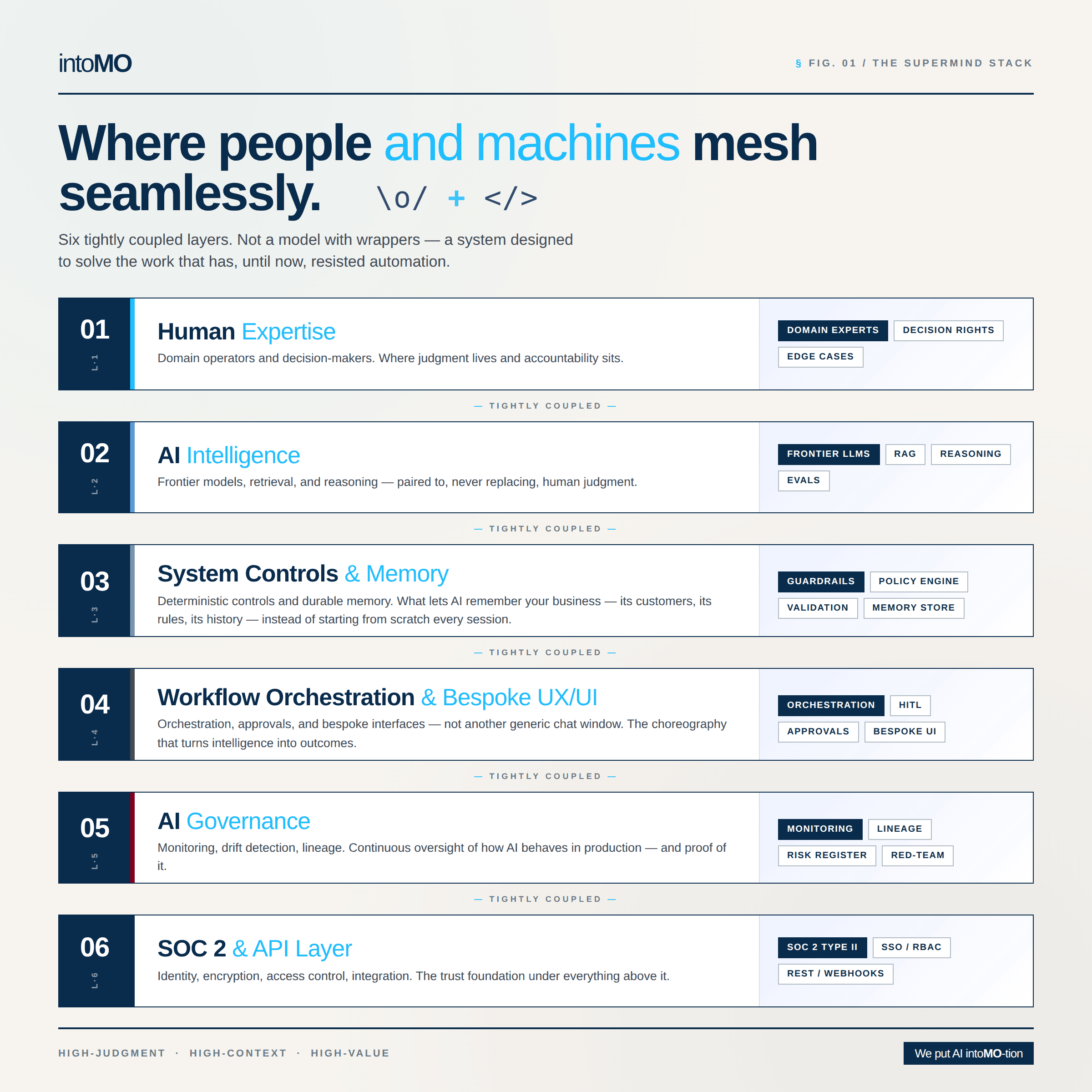
The key point: a Supermind is a custom, human-governed implementation of agentic AI, built for production. It runs on an enterprise LLM, retrieves like a chatbot, calls vertical tools, and orchestrates agents inside human-gated steps, wrapped in the controls, memory, and governance that make it safe for mission-critical work. What sets it apart from an off-the-shelf agent is not the model but the structure around it, and where the decision sits: agents optimize for autonomy, a Supermind for amplified human judgment. The companion Architecture paper covers how one is built.
How to choose, and where to start
Before choosing a tool, classify the problem. Four questions place almost any use case:
How costly is a wrong answer? Low stakes favors off-the-shelf tools. High stakes favors structure and human accountability.
How much judgment does it require? Routine and deterministic favors automation. Nuanced and contextual favors a decision system.
How important is a differentiated, proprietary solution, versus a standardized one? A problem that looks standard may still be one you want to own and differentiate on. Where differentiation matters, lean toward building; where it does not, a shared, off-the-shelf solution is fine.
How sensitive and regulated is the data? Heavier compliance raises the value of governance, lineage, and access control.
If the problem looks like this | The right class is usually |
|---|---|
Drafting, research, or brainstorming for individuals | An enterprise LLM platform |
Answering questions over your own documents | A custom chatbot (RAG) |
A standard workflow many firms share | A vertical AI product (buy, don’t build) |
Small assists inside tools you already use | AI in your SaaS (copilots) |
Multi-step automation you can run with limited supervision | AI agents, with the right guardrails |
A high-value process unique to you, where errors are costly | A decision system (Supermind) |
Opportunity-First (vs. tools-first): Most firms will run several of these classes at once, and that is fine. There is no one-size fits all solution for all of your business needs.
We caution against taking a tool-first rather than problem-first (or opportunity-first) approach. A tools-first approach can be attractive. Perhaps a peer is using a tool and you do not want to be left behind. We are not saying a given AI tool is good or bad, rather, we suggest digging deeply into the question: “Is it the best tool for a high-value problem you need to solve?”
At intoMO, we believe the value of AI shows up in one place: improved business outcomes. That conviction shapes how we work. Good strategy has its place, but a broad, organization-wide AI plan can take months to produce, and at the pace AI moves, much of it is dated before anything ships. So we are built around outcomes, not deliverables: take time to identify your top AI opportunity(ies), then put AI into production where it changes the business.
What we have found moves the needle most on real business outcomes is to solve one important problem (realize one important opportunity) at a time, get benefit from it, learn from it, and then extend it. The process we recommend is:
First, identify the top one or two problems or opportunities best suited to an AI solution.
Second, consider which class of solution best fits those problems.
Third, research the options and vendors within that class, and choose the one best suited to solve it. In cases where the opportunity scales your unique expertise and judgement (or involves complex, high-judgment, mission-critical processes; or areas where a proprietary solution would give you a distinct advantage), consider a bespoke Supermind.
At intoMO, this is how we work. We partner closely with clients in an intense two-week Discovery and Design Sprint, grounded in Jobs-to-be-Done (Christensen) and Outcome-Driven Innovation (Ulwick), two of the most rigorous and proven methods for prioritizing the problems and opportunities that matter most. In fact, we built our own Design Sprint Supermind to amplify our expertise, to sharpen and accelerate that work.
Need help identifying your highest-value problem?
intoMO’s 2-week Discovery & Design Sprint can help. Contact us at info@intomo.ai
We put AI intoMO-tion. intoMO.ai
\o/ + </>