The Four Stages of AI Maturity
Is your firm winning the AI adoption race? If you're stuck in stage 1 or 2, intoMO can help.
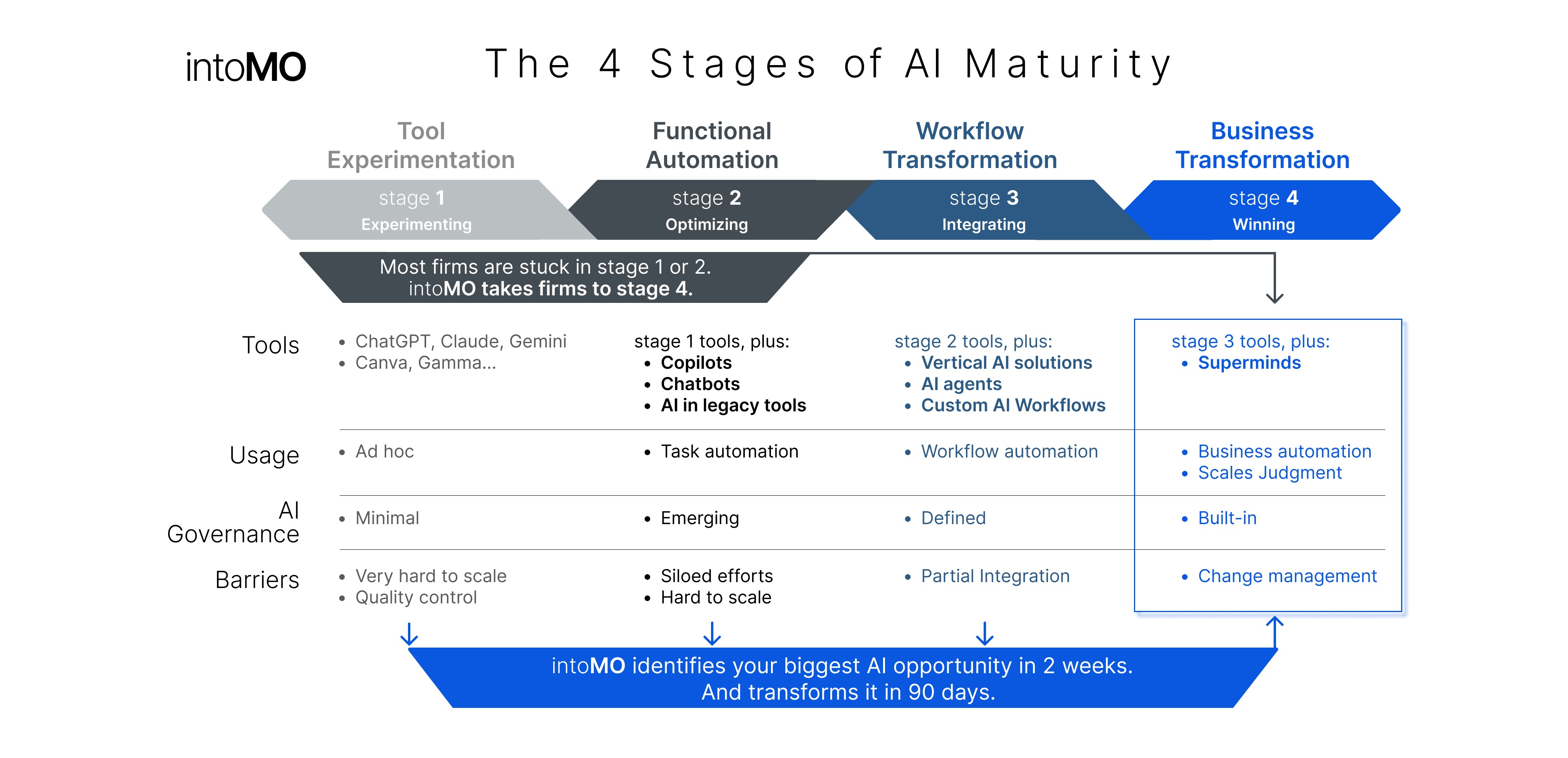
The 4 Stages of AI Maturity
At intoMO, we build Superminds that amplify a company’s unique expertise to address its most valuable opportunities. Superminds are bespoke applications that integrate human expertise, AI, workflows and user experience
Not generic tools.
Not pilots.
But production systems that combine your team’s expertise with AI to transform how critical work gets done.
Most companies are already using AI.
But very few are seeing meaningful business impact.
According to Deloitte’s State of AI 2026, only about 34% of enterprises are using AI to deeply transform their business.
In our experience working with mid-market firms, that number is likely even lower.
What we consistently see is this:
Companies aren’t failing to adopt AI.
They’re getting stuck in the middle.
AI Adoption Follows a Pattern
Across industries, AI adoption tends to move through four stages:
Tool Experimentation
Functional Automation
Workflow Transformation
Business Transformation
Each stage builds on the last—but the jump from Stage 3 to Stage 4 is where the real value is created.
Let’s make each stage concrete.
Stage 1: Tool Experimentation
“People are trying AI”
This is where almost every company starts.
Teams begin using tools like:
ChatGPT, Claude, Gemini
Canva, Gamma, Midjourney
Notion AI, Perplexity
Usage is:
ad hoc
individual
inconsistent
What it looks like in practice
A marketing manager uses ChatGPT to draft emails
An analyst summarizes reports
A consultant brainstorms before a client meeting
There’s real value here:
faster work
better first drafts
time savings
But the work itself hasn’t changed.
The limitations
Outputs vary widely by user
There’s no shared process
Nothing is connected to systems or workflows
Common barriers:
inconsistent use
quality control issues
inability to scale
AI is helping individuals—but not the business holistically.
Stage 2: Functional Automation
“Some teams are getting leverage”
In Stage 2, AI moves beyond individuals and into departments.
You’ll see tools like:
Copilots
Chatbots
AI embedded in existing systems
Usage becomes:
task automation
repeatable within a function
What it looks like in practice
Customer support uses AI to draft and triage tickets
Marketing automates content creation
Recruiting screens candidates with AI
Engineering teams use AI-assisted coding
Now you start to see:
measurable productivity gains
faster output
cost savings
The limitations
Each function operates independently.
Marketing doesn’t connect to sales
Sales doesn’t connect to onboarding
Onboarding doesn’t connect to delivery
Common barriers:
siloed efforts
hard to scale
AI is improving parts of the business—but not how the business runs.
Stage 3: Workflow Transformation
“AI is built into how work gets done”
This is where things start to change meaningfully.
AI is embedded into workflows:
vertical AI solutions
AI agents
custom AI workflows
Usage becomes:
workflow automation
process-level improvement
What it looks like in practice
Meetings are transcribed, summarized, and turned into follow-ups automatically
Sales workflows capture discovery and suggest next steps
Onboarding systems pull data and flag gaps
Now the benefits are stronger:
more consistent execution
better use of data
fewer manual handoffs
The limitations
Even here, most companies stop short.
Because:
workflows are improved—but not rethought
human judgment is loosely connected
systems don’t fully coordinate
Common barrier:
partial integration
The work is faster—but not fundamentally different.
Stage 4: Business Transformation
“AI changes how the business operates”
This is where AI becomes a competitive advantage.
At this stage:
AI is designed into how work runs
systems combine human expertise + AI continuously
entire parts of the business operate differently
This is not about speed.
It’s about dramatically better outcomes.
What it looks like in practice
Take a common example: client onboarding.
Before (Stage 1–3)
Data comes from emails, fillable PDF’s, other documents, calls
Information is manually stitched together
Advisors chase inputs
Insights come late
Even with AI:
pieces are faster
summaries are better
but the process is still fragmented
With a Stage 4 (Supermind) system
Onboarding is run as a Client Experience System:
Data is gathered through a guided experience
AI validates inputs across sources in real time
Gaps are flagged immediately
Insights are generated continuously
The advisor focuses on judgment—not data gathering
The result
faster onboarding
consistent quality
earlier insights
more revenue opportunities
👉 This is business automation
👉 It scales judgment, not just output
What’s different at Stage 4
Governance is built in
Systems coordinate across workflows
Expertise is embedded into execution
The challenge becomes:
managing growth
scaling what works
Why Most Firms Get Stuck
Across all four stages:
Stage 1 → easy
Stage 2 → common
Stage 3 → achievable
But Stage 4 requires something different.
You have to design how AI and human expertise work together
at the system level
This is where most organizations stall.
Not because of technology.
But because:
workflows aren’t fully understood
systems aren’t connected
ownership is unclear
the problem isn’t precisely defined
The Shift That Matters
The difference between stages is not technical.
It’s this:
Is AI layered onto work—or built into how the work runs?
That is the dividing line between:
incremental improvement
and real transformation
How intoMO Helps
We help companies move to Stage 4.
1. Design Sprint (2 weeks)
We identify your highest-value AI opportunity—
where impact is real, measurable, and worth solving.
We then design the solution, working side-by-side with you the whole time.
2. Build & Deploy (~90 days)
We design and implement a Supermind that:
meshes your expertise with AI
runs a real part of your business
removes adoption barriers
Final Thought
Most firms are using AI.
Very few are using it to change how their business actually operates.
The goal is not to use AI more.
It’s to turn your firm’s best work into something that runs.
If this resonates, we’d be happy to help you identify where that opportunity is in your business.
👉 Contact us at for more information and a demo of an intoMO Supermind at work.


