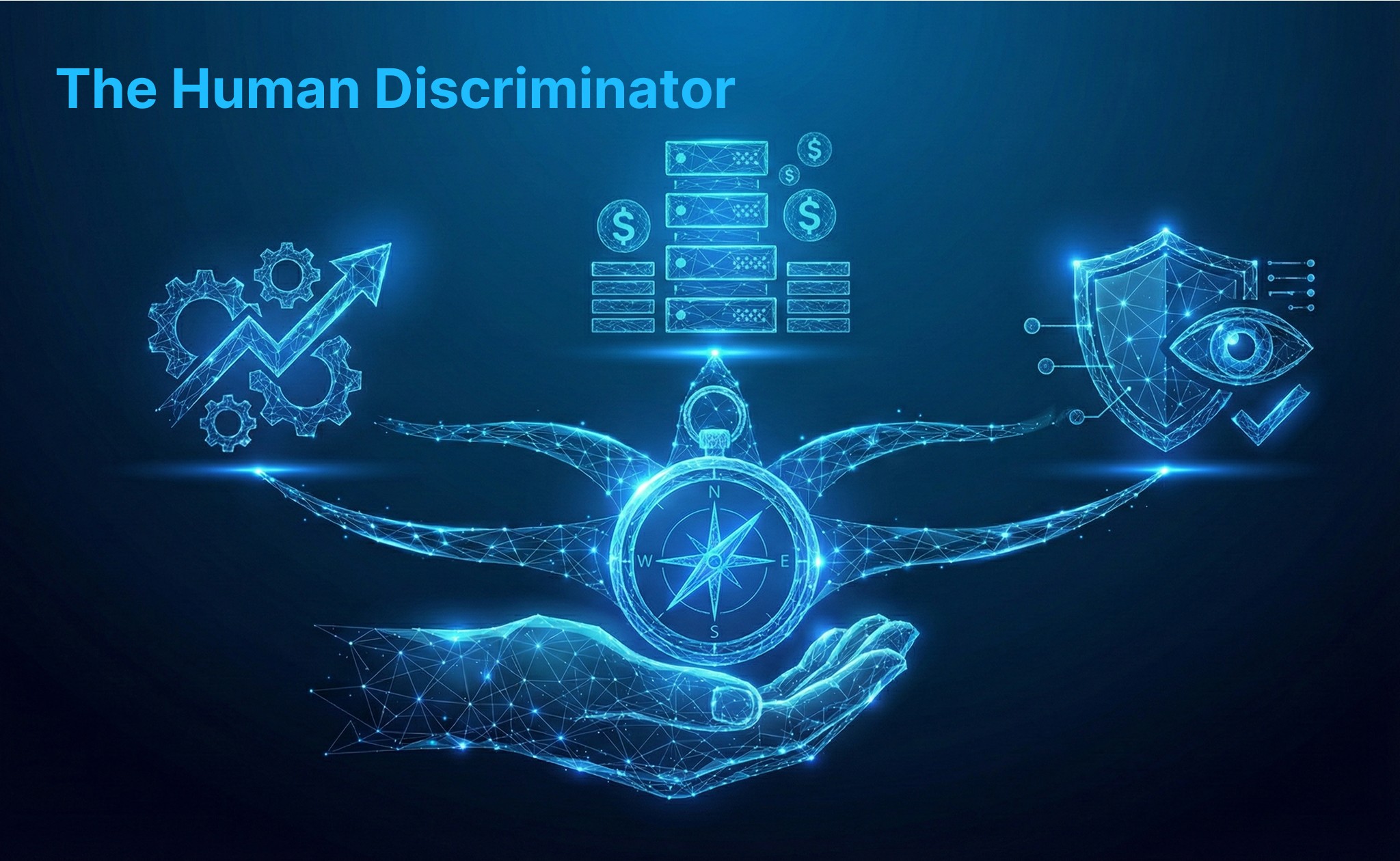
The Human Discriminator: Architecting Generative AI for Truth and Impact
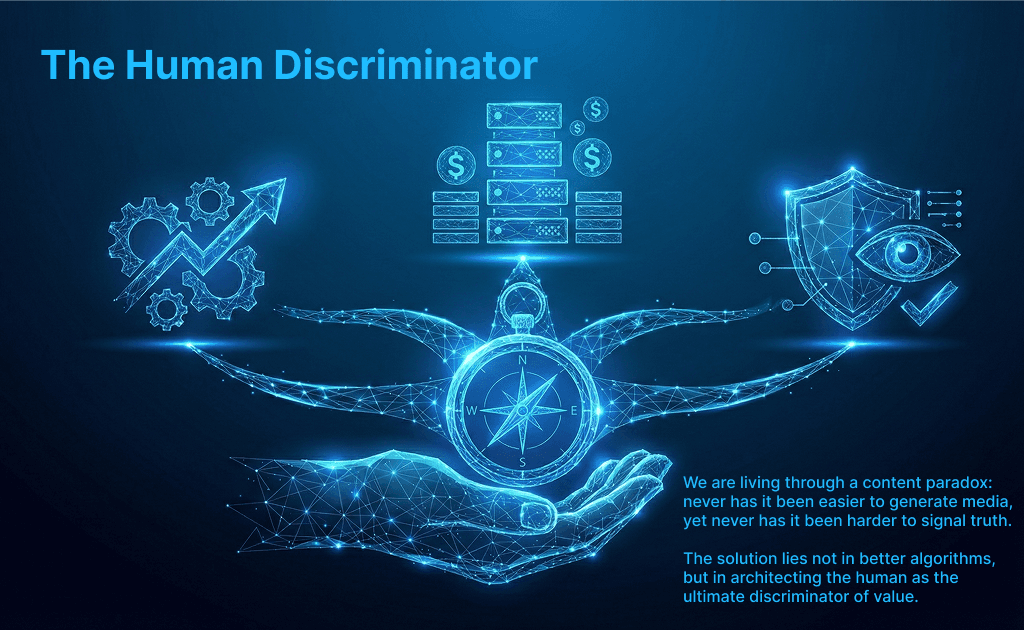
We are living through a content paradox. Never in history has it been easier to generate media, yet never has it been harder to signal truth and achieve trust.
For product leaders, non-profits, and founders, this "content explosion" is not natively an asset; it is an obstacle. The sheer volume of noise makes it nearly impossible for lean teams to communicate complex ideas effectively. While the largest corporations can afford high-fidelity storytelling, the innovators and social enterprises, the ones who often need to be heard the most, are drowned out.
The foundational philosophy for solving this comes from Andrew Lippman, Associate Director of the MIT Media Lab. I explored his research with "Viral Communications" in his module of MIT’s Designing and Building AI Products and Services course, where my applied work on GANs was recognized with an Outstanding Assignment Award. Lippman distinguishes between static "answer machines" and dynamic "conversation machines," arguing that to build systems that engender trust in a noisy world, we must create media that actually "knows" its content.
In this post, I’ll build on that foundation, focusing less on theory, and more on how I applied Lippman's framework to design NarrativeOS, a "narrative engine" built to democratize agency-quality storytelling. The result is a blueprint for building AI products that balance raw generative power with radical responsibility.
Core Philosophy: The Human as the Discriminator
To understand how AI can serve the good of society, we must look at the mathematical architecture of a Generative Adversarial Network (GAN). A GAN consists of two neural networks working in opposition:
The Generator: Think of this as the "Artist" that creates content, such as images or video, from scratch.
The Discriminator: Think of this as the "Critic" that judges whether the content is true or realistic, guiding the artist to improve.
In most commercial applications, both parts are machines. However, in NarrativeOS, we have architected the workflow so that the Human acts as the Discriminator.
This "Human-in-the-Loop" (HITL) design pattern turns the AI from a replacement into a force multiplier. While the AI generates the raw creative potential—the video storyboards, the neural audio, the copy—the human provides the critical judgment. In academic terms, this prevents the AI from optimizing solely for statistical probability and ensures it optimizes for human nuance and truth.
Pillar 1: Sustainability
A product is only "for good" if it can survive the market long enough to make an impact.
The sustainability of NarrativeOS lies in its ability to bridge the "Workflow Gap." Currently, there is a massive disparity between "technical documentation" and "emotional assets." Creating an attractive video presentation for a product is expensive, generally costing anywhere from "$600 to infinity" and requiring weeks of specialized labor.
By automating the transition from text to multimedia (Video/Audio), we compress a process that usually takes weeks into minutes. This is not just efficiency; it is democratization. By leveling this playing field, we allow an NGO or a bootstrapped founder to wield the same persuasive power as a Fortune 500 company. Sustainability here means creating a tool that empowers the "underdog" economy.
Pillar 2: Feasibility
Feasibility is where the idealism of AI meets the reality of engineering. Unlike traditional software, Generative AI introduces significant variable costs (through inference).
In architecting the financial model for NarrativeOS, we had to reject the ad-supported "free tier" model common in B2C apps. High-quality neural audio and video rendering are computationally expensive; relying on free tiers often leads to unsustainable unit economics.
To make this feasible, the architecture relies on a B2B SaaS subscription model. This aligns the incentives correctly: the user pays for the value of the asset (a finished commercial), not the novelty of the tech. Furthermore, by using a Composable Stack (Next.js, Vercel AI SDK), we avoid the massive technical debt of training proprietary base models. We do not need to own the "brain"; we only need to own the "connective tissue" that makes the brain useful.
Pillar 3: Responsibility
This is the most critical pillar. When we deploy powerful generative models, we bear a societal responsibility to prevent "Machine Lying"—the phenomenon where AI generates convincing but false information.
Because algorithmic detectors often end up in an unwinnable "arms race" with generators, NarrativeOS treats ethics not as compliance, but as a feature—an "Ethical Moat."
Reliability via Grounding: The system is legally "blind" until a human verifies the data. We enforce HITL stops where the user must explicitly audit the "Ingested Context" before the AI is allowed to write a script.
Transparency via RAG: We utilize Retrieval-Augmented Generation (RAG) to actively crawl the web and validate market claims, providing URLs for every fact. As the research warns, without this grounding, enhancing low-resolution data is often "in large measure, imagination" rather than reality. We ensure our system relies on verifiable facts, not imagination.
Fairness: Static training data is often biased. By connecting the system to live web search, we ensure personas are based on current market realities, not historical prejudices.
The Verdict
We are past the phase of being impressed that an AI can speak. We must now demand that it speaks truthfully.
NarrativeOS represents a shift in how we view these tools: not as replacements for human creativity, but as force multipliers for human intent. By rigorously evaluating our architecture against Sustainability, Feasibility, and Responsibility, we prove that the true value of GANs and LLMs isn't in the pixels they generate—it's in the potential they unlock for society.
References
Lippman, A. (2025). Introduction to AI and Media. MIT xPRO.
Rahwan, I. (2025). The Moral Machine.
Fujii, T., et al. (2019). HumanGAN: Generative Adversarial Network with Human-based Discriminator.


